Kent and Medway local government reorganisation (LGR) could be one of the biggest changes to local public services in the county for more than 50 years.
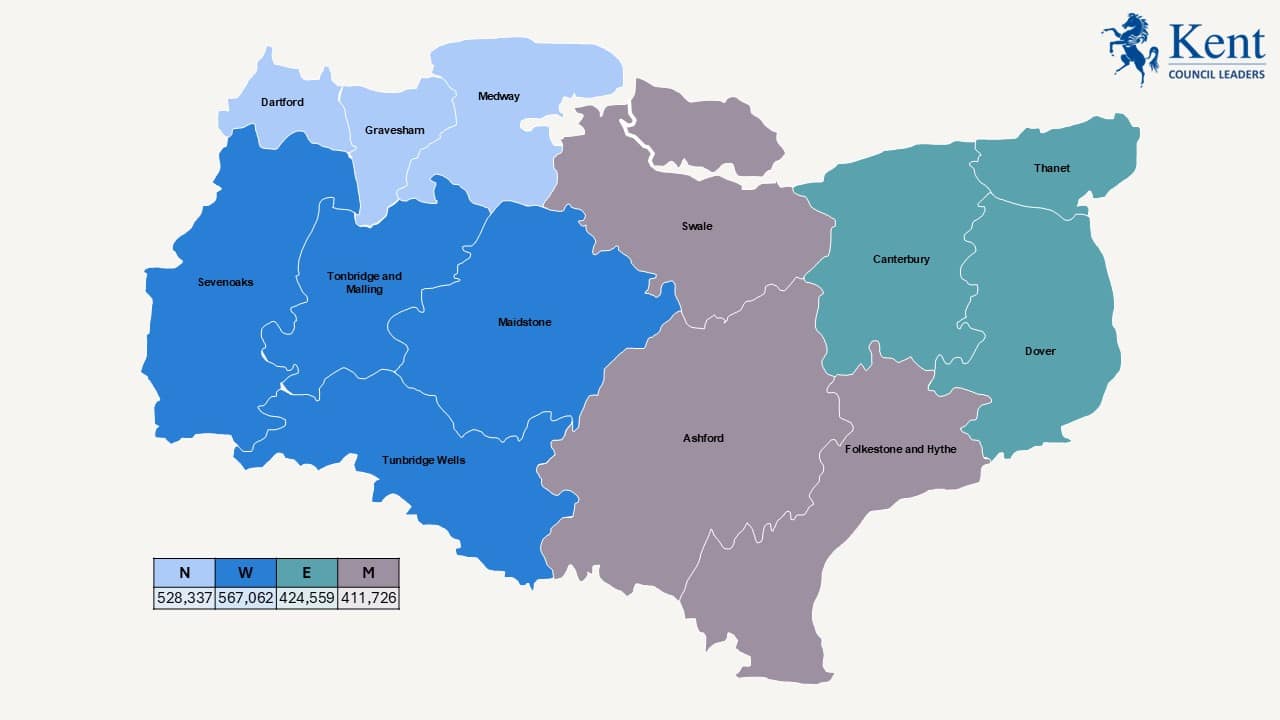
KentOnline reports that the government is expected to choose “option 4b” for the Kent and Medway local authority reorganisation. If confirmed, the current county, district, borough, and Medway council arrangements would be replaced by four new unitary authorities.
At this stage, charities should treat the detail with caution until there is a formal government announcement. But it is significant enough that boards and senior teams should start thinking about what it could mean.
What has been reported
According to KentOnline, the proposed four unitary authorities would be:
| Proposed area | Current council areas included |
|---|---|
| North Kent | Dartford, Gravesham, Medway |
| West Kent | Sevenoaks, Tonbridge and Malling, Maidstone, Tunbridge Wells |
| Mid / South Kent | Swale, Ashford, Folkestone and Hythe |
| East Kent | Canterbury, Thanet, Dover |
This would end the two-tier system in Kent, where district and borough councils currently manage some services, while Kent County Council is responsible for larger services such as highways, education, and social care. Medway, currently a unitary council, would become part of the proposed north Kent authority.
For residents, services are not expected to change immediately. But for charities and voluntary sector organisations, the medium-term implications could be substantial.
Why this matters locally
Kent local government reorganisation is not just a council structure issue. It could affect how charities are funded, commissioned, referred into, involved in partnerships, and heard in local decision-making.
This is particularly relevant for organisations working in:
- mental health and wellbeing
- children and young people
- homelessness and housing
- addiction and recovery
- domestic abuse
- social care and community support
- public health
- community transport
- advice, advocacy, and poverty support
- local infrastructure and community development
Many charities have spent years building relationships with Kent County Council, Medway Council, district councils, councillors, commissioners, public health teams, community safety partnerships, housing teams, and local voluntary sector networks.
If the reported model is confirmed, those relationships may need to be remapped.
Issues to watch
1. Commissioning and contracts
Any charity with local authority income should review which council currently funds or commissions each service.
Some contracts may transfer smoothly. Others may be extended, redesigned, grouped into larger areas, or recommissioned under new structures. This could create risk, but also opportunities for charities that can clearly show impact, local reach, and readiness to work across wider geographies.
A practical first step is to map:
- which council funds each service
- when each contract or grant ends
- which proposed unitary area the service sits in
- whether the service crosses more than one proposed boundary
- who currently manages the relationship
2. Local relationships and influence
Charities often rely on strong relationships with councillors, officers, commissioners, and local partnerships.
Larger unitary authorities may mean new portfolio holders, new senior officer teams, new scrutiny arrangements, and new decision-making routes. Some existing relationships may continue. Others may disappear or shift into new roles.
Charities should be ready to explain their local value clearly and consistently. This will matter when new authorities are setting priorities, designing structures, and deciding how they work with the voluntary, community, and social enterprise sector.
3. Place and identity
Many Kent charities are deeply rooted in specific towns, districts, and communities. Local identity matters.
A larger unitary authority may bring efficiencies, but it can also create distance between decision-makers and local communities. Charities may need to make the case for place-sensitive commissioning, local delivery, and meaningful community engagement.
This will be especially important for smaller charities whose value comes from trust, local knowledge, and long-standing relationships.
4. Partnership structures
Local partnerships may also change. Boards, forums, networks, and working groups that currently operate around county, district, borough, or Medway boundaries may need to be reviewed.
That could affect safeguarding, health, housing, community safety, mental health, children’s services, public health, and voluntary sector infrastructure.
For charities, the key question is: where will the real conversations happen under the new structure?
5. Funding risk and opportunity
Local grants, councillor funds, community funds, public health budgets, and commissioned services may all be reviewed during the transition.
Some funding may be protected in the short term. But over time, new councils will need to make decisions about priorities, budgets, and delivery models.
Charities should avoid panic, but they should not wait passively either. This is a good moment to strengthen impact evidence, update case studies, understand income exposure, and prepare clear messages about why local voluntary sector provision matters.
Preparing for the Kent Local Government Reorganisation
The formal detail still needs to be confirmed, so this is not the moment for drastic decisions. But it is the right time for preparation.
Boards and senior teams may want to:
- Add Kent local government reorganisation to the risk register
Treat it as an external strategic risk, especially if the charity relies on council funding, referrals, premises, partnerships, or local authority data. - Map local authority income and relationships
Identify which services, grants, contracts, and partnerships are linked to which current councils. - Review contract end dates and recommissioning points
Pay close attention to services due for renewal during the transition period. - Update stakeholder maps
Track current councillors, officers, commissioners, and partnership leads. Be ready to update this once shadow structures are confirmed. - Prepare a concise impact narrative
Be clear about who you support, where you work, what outcomes you deliver, and what would be lost if local voluntary sector provision is weakened. - Work with local networks
Voluntary sector infrastructure bodies and charity networks will be important in making sure the sector has a voice during the transition.
Start by mapping exposure
If the reported model is confirmed, Kent and Medway charities should not treat this as a distant governance change. It is likely to affect funding, commissioning, partnerships, public service pathways, and local influence over the next few years.
For now, the best approach is to stay calm, track the formal announcement, and start mapping exposure.
Charities that understand their local authority relationships, can evidence their impact, and can explain their value clearly will be in a stronger position as the new structures take shape.
Sailfin supports charities with strategy, governance, funding, and organisational development. If your organisation needs to understand what local government reorganisation could mean for your funding, partnerships, or commissioning position, we can help you map the risks and plan your next steps.